
Last updated September 16, 2026
DIY vs Professional Insulation: The El Monte Homeowner’s Decision Guide
Most El Monte homeowners walk into the DIY insulation question backwards. They start with the price tag, then work their way toward whether they *can* do it. But here’s what twenty years of crawling through San Gabriel Valley attics teaches you: the real question isn’t whether you can physically operate a blower machine from Home Depot. It’s whether a mistake you make in a 140-degree attic is something you can afford to live with for the next decade. Because insulation failures don’t announce themselves. They show up quietly on your August SCE bill, in the mildew smell that settles into your hallway, in the $900 pest remediation quote you get three years after mice took up residence in the batts you installed against the roofline. This guide breaks down every insulation task in El Monte’s housing stock, street by street if necessary, and tells you exactly where the DIY line sits. For more guides & resources, visit our blog.re it doesn’t.
Quick Answer
DIY insulation in El Monte is genuinely viable for exactly one scenario: adding blown-in fiberglass or cellulose on top of existing, dry, uncontaminated attic insulation with clear access and no electrical or moisture complications. Professional insulation work is necessary when you’re removing old or contaminated insulation, air sealing, dealing with any pre-1955 wiring, touching walls or crawl spaces, or working with spray foam. The honest cost difference is smaller than most calculators suggest, especially once you factor in retail material pricing, equipment rental, disposal, and the simple fact that a missed air-sealing step can erase every dollar of savings. See our Insulation Cost Breakdown: The El Monte Homeowner’s Reference for 2026 for detailed numbers.
Table of Contents
- The Real Decision Variable: Reversibility
- Where DIY Is Genuinely Appropriate in El Monte
- The Air Sealing Gap: Why R-Value Alone Doesn’t Matter
- The Knob-and-Tube Exception: Pre-1955 El Monte Homes
- The Permit Trigger: When DIY Work Jeopardizes Your Other Projects
- The Honest Cost Comparison: What DIY Actually Nets
- Where Professionals Earn Their Bid: Walls, Crawl Spaces, and Removal
- Material Matching Matters: Why One Brand Doesn’t Fit Every Home
- Common Mistakes to Avoid
- When to Call a Professional
- Frequently Asked Questions
- The Bottom Line
The Real Decision Variable: Reversibility
Every insulation task sits somewhere on a spectrum between fully reversible and permanently consequential. Adding loose-fill insulation to an attic floor that’s dry, structurally sound, and free of wiring complications is reversible. You can vacuum it out. You can move it around. Worst case, you call someone like us at Pacific Insulation El Monte home to fix it, and the fix is straightforward.
Removing old insulation that’s been soaked by a roof leak, compacted by decades of rodent traffic, or contaminated by pest waste is not reversible in any practical sense. If you tear out batts, drag them through your house, bag them up, and run them to a dumpster, you’ve now introduced whatever was living in that insulation into your living space and your HVAC system. If you seal air bypasses incorrectly, you’ve potentially trapped moisture inside a wall cavity where it will condense, feed mold, and rot framing. That mistake compounds silently for years before you see it with your own eyes.
The reversibility lens is useful because it forces an honest conversation about risk tolerance. We’ve seen El Monte homeowners in the North El Monte hills who tried to remove old attic insulation with a shop vac and a prayer. The result was a two-week cleanup, a clogged vacuum motor, and a call to us anyway because they’d disturbed eight decades of dust, rodent droppings, and fiberglass into an airborne cloud inside their home. Some things you can un-do. Some things you can only call in a professional to re-do correctly, and often at a higher cost than if you’d hired it done right the first time.
Where DIY Is Genuinely Appropriate in El Monte
We’re not here to tell you that every insulation task requires a professional. That would be dishonest. There are three El Monte-specific scenarios where a competent, physically able homeowner can do legitimate insulation work with good results.
Scenario One: Adding Blown-In Insulation on Top of Existing Attic Insulation
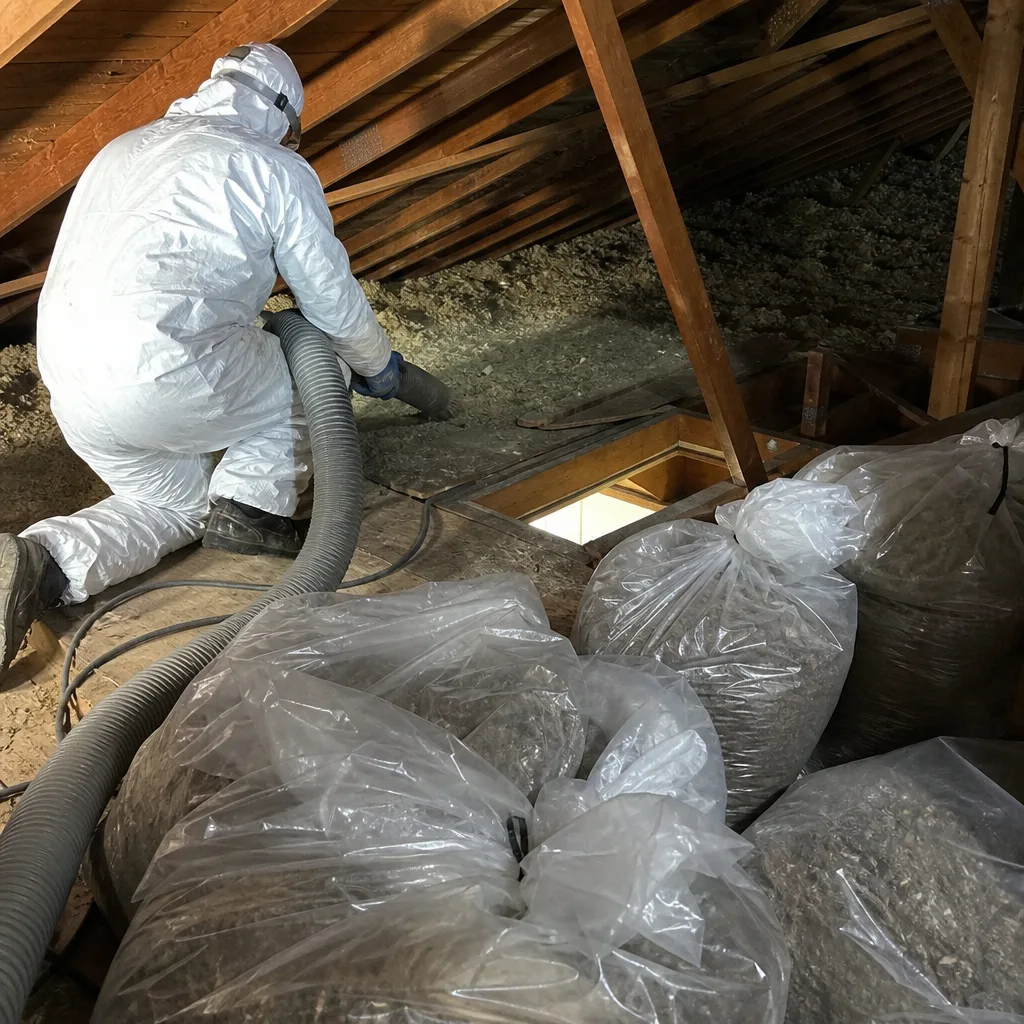
If your attic already has insulation but it’s settled thin to the point where you can see the ceiling joists, and you’ve confirmed there are no signs of moisture staining on the decking, no rodent droppings, and no knob-and-tube wiring, adding blown-in fiberglass or cellulose on top is a viable weekend project. You rent a blower machine from a local supplier. Home Depot in El Monte rents the Atticat machine, and the rental is typically free with the purchase of 20 or more bags of their pink blown-in fiberglass. Other local rental yards in the San Gabriel Valley will charge $60 to $100 per day for a similar blower, but you’ll pay retail for the material, usually $35 to $50 per bag depending on the R-value you’re targeting.
The physical work is straightforward: one person feeds the hopper in the garage or at the attic hatch while the other person runs the hose in the attic. El Monte attics in post-1960 homes are almost all accessible through a hatch in a hallway or closet, and if the home has a truss roof, the attic is open enough to move around with care. If it’s a pre-1955 home with a low-pitch or nearly flat roof, there may be no attic access or a crawl-style attic with six inches of clearance, and DIY becomes a nonstarter quickly.
Scenario Two: Wrapping Exposed Ductwork and Pipes
If you have exposed ductwork in a basement or crawl space (rare in El Monte, but common in the older homes near Mountain View which have raised foundations), you can absolutely wrap those ducts with insulated duct wrap or pipe insulation yourself. This is low-risk, high-reward work that requires no permit, no inspection, and no specialized equipment beyond a utility knife and foil tape. The key is getting the vapor barrier orientation correct, and getting an airtight seam, which is a lot more finicky than most YouTube tutorials suggest, but it’s learnable.
Scenario Three: Weatherstripping, Caulking, and Basic Envelope Sealing
Sealing the gaps around windows, doors, baseboards, and plumbing penetrations on the interior side of your El Monte home is the single highest-ROI DIY insulation project available. A tube of OSI Quad caulk, a roll of V-seal weatherstripping from the hardware store, and a few foam gaskets behind your outlet covers on exterior walls will cost you under $100 and will cut air infiltration more than most people expect. This is not “insulation” in the R-value sense, but it functions as part of your thermal envelope, and it’s work any homeowner can learn to do correctly in an afternoon. If you’d rather have this done as a complete system, Attic Insulation in El Monte services include the full scope of air sealing, from the attic floor down to the sill plates.
The Air Sealing Gap: Why R-Value Alone Doesn’t Matter
Here’s the thing almost no DIY blog will tell you: fiberglass and cellulose insulation work by trapping *still air*. That’s it. They don’t stop air movement. They create dead air space. If air is moving through your attic floor, through the gaps around your recessed lights, through the open chase where your plumbing stack rises, through the seam where your drywall meets your top plate, that moving air strips heat from your insulation as fast as the insulation can accumulate it.
In building science terms, a typical El Monte home built in the 1970s or 1980s has enough combined air bypass area in its attic floor to equal the surface area of an open double-hung window. When you add R-30 blown fiberglass on top of that unsealed floor, you’re essentially spreading insulation over a screen door. The R-value is on the bag, but the performance is nowhere near the rating. The thermal readings we’ve taken in El Monte attics before and after air sealing consistently show that sealing bypasses first and then insulating produces 40% to 60% better comfort outcomes than insulating alone, with the same material and the same R-value.
This is where the professional value proposition gets concrete. Air sealing requires you to locate the bypasses, which means moving insulation out of the way and visually identifying every penetration in the building envelope: top plates, wire penetrations, plumbing chases, fireplace flues, recessed light housings, bathroom fan vents, HVAC boots. In a typical attic, that’s 30 to 50 points of failure. Each one gets sealed with the correct material: fire-rated caulk for high-temperature penetrations, foam board and spray foam for large openings, specific tapes for duct boots. Get the order or the material wrong, and you’ve created a moisture trap or a fire hazard. Skip one of the 50 points, and you’ve left a thermal hole that defeats the entire project. This is specialized building science, not cranking a blower machine. It’s also the primary difference between what a home energy audit measures and what an insulation bid assumes.
The Knob-and-Tube Exception: Pre-1955 El Monte Homes
El Monte’s housing stock is older than most of the newer SGV cities. The city was incorporated in 1912, and the explosion of residential construction happened between 1920 and 1960. A significant percentage of El Monte homes built before 1955 still have active knob-and-tube wiring in the attic and walls. If you own one of these homes, the DIY insulation conversation changes completely.
Knob-and-tube wiring is an open-air electrical system. The wires run through ceramic tubes in the joists and around ceramic knobs nailed to the framing. The wire insulation is rubber or cloth-covered, and after seventy or eighty years in an El Monte attic, it’s brittle, cracked, or disintegrating. The system was never designed to be buried in thermal insulation. When you cover knob-and-tube wiring with fiberglass or cellulose, you trap the heat the wire generates during normal operation. The heat has nowhere to dissipate. The brittle insulation breaks down faster or ignites. This is a known, documented fire mechanism, not a hypothetical.
If your El Monte home has knob-and-tube wiring, any insulation work near or above that wiring requires a licensed electrician’s sign-off first. Usually that means the electrician confirms the system is in good condition and safe to insulate over (rare for 80-year-old wiring), or the system is decommissioned and replaced with Romex before insulation goes in. The electrical retrofit alone can run $8,000 to $15,000 in an average El Monte home, but the alternative is either an uninsulated attic (which means brutal August heat and winter cold) or an uninsurable fire hazard. Skip this step at your own risk, and know that when you sell, a competent home inspector will flag it and the buyer will negotiate the cost out of your sale price anyway. This is a disclosure issue.
The Permit Trigger: When DIY Work Jeopardizes Your Other Projects
California building codes are specific about insulation requirements, and El Monte’s building department enforces Title 24 energy efficiency standards on any permitted project that touches the thermal envelope. Before you start, read our Insulation Permits, Codes & Inspections in CA: What You Need to Know. Here’s the scenario that bites DIY homeowners every single year:
You pull a permit for an HVAC replacement. The El Monte inspector comes out, checks the new condenser and air handler, and then asks about the attic insulation, because Title 24 requires that a permitted HVAC change-out include verification that the attic meets current insulation minimums. You tell the inspector you added R-30 yourself last year. The inspector asks for the installation certification, the material documentation, and the air sealing checklist. You don’t have them. The inspector fails the permit. Your HVAC contractor won’t release the final invoice, the equipment warranty registration is incomplete, and you’re now paying a professional to re-do or certify insulation work that you thought you’d done correctly. We’ve seen this exact chain of events happen more than once in El Monte.
The broader point: any time you pull a permit in El Monte for a project that touches the building envelope, your DIY insulation work can become a liability under that permit. A professional insulation installation comes with documentation: material specs, installation dates, air sealing verification, and in some cases a third-party HERS rater sign-off. That paperwork is what gets you through inspection. DIY work rarely has it.
The Honest Cost Comparison: What DIY Actually Nets
Let’s get specific about what a DIY attic insulation add-on costs in El Monte in 2025 dollars, compared to a professional bid. We’ll use a typical 1,200-square-foot El Monte ranch house with a 1,000-square-foot attic floor and an existing 3 to 4 inches of old fiberglass.
DIY Material and Equipment Costs:
- Blown-in fiberglass, R-30 add-on over existing insulation: 25 to 30 bags at $38 to $45 per bag retail: $950 to $1,350
- Blower machine rental: free with purchase at some retailers, or $60 to $100 per day at rental yards
- Personal protective equipment: Tyvek suit, N95 respirator, knee pads, work gloves, headlamp: $75 to $120
- Basic air sealing supplies (which most DIYers skip entirely): caulk, foam, gaskets: $40 to $60
- Disposal of old materials if you’re removing, not just adding: $150 to $400 for dumpster or haul-away
- Total DIY cost, add-on only: approximately $1,100 to $1,500, plus one full day of physical labor in an attic that can reach 130°F in August
Professional Bid Comparison:
A professional blown-in insulation job from a company offering full air sealing and
assessments typically runs $1,600 to $2,400 for that same El Monte attic, including air sealing, material, installation, and labor. The difference is $500 to $900 on paper.
But adjust for what the professional bid includes that the DIY number doesn’t: the air sealing work, which is the single biggest determinant of whether your new R-value performs anywhere near its rating. The thermal boundary assessment, which tells you whether the insulation belongs on the attic floor or in the roofline. The disposal of any material that needs to come out. Warranty coverage on the installation. Rebate eligibility. In our experience at Pacific Insulation El Monte, the homeowners who do this kind of math honestly typically realize the “savings” is closer to $300 or $400, and they’re trading that for a full day of intense physical labor in extreme heat, with the very real possibility of making a mistake they can’t see or feel.
One of the services we provide that most changes the calculation is the home energy audit. It tells you exactly where your conditioned air is escaping before you spend a dollar on material. That’s the diagnosis-first approach we take, and it’s why we suggest every El Monte homeowner start there, not with a pile of bags from the home center. We detail what we check during these audits on our Spray Foam Insulation in El Monte page, and the same principles apply to every material type.
Where Professionals Earn Their Bid: Walls, Crawl Spaces, and Removal
There’s a class of insulation work where the professional isn’t just a better option; they’re the only responsible option. Walls, crawl spaces, and removal all fall into this category, and the reasons are structural, not commercial.
Wall Insulation
Adding insulation to existing closed walls in El Monte is not a DIY project under any reasonable definition. The work involves drilling holes through exterior stucco or siding (or working from the interior drywall side), blowing dense-pack insulation into each stud bay, confirming fill density with a thermal camera, and patching the holes to match. Dense-pack wall insulation requires equipment that produces the correct pressure and fill rate. Under-filled bays leave thermal voids. Over-pressurized fills can bow drywall, crack plaster, and pop drywall seams. Neither mistake is visible from the outside, and neither is reversible without opening the wall.
That said, if you’re doing a renovation that opens the walls anyway, this is where material matching matters. Some El Monte homes benefit from Blown-In Insulation in El Monte for open bays, others are better served by spray foam, especially in the floor system above a crawl space. In our experience, the choice comes down to air sealing goals, moisture profile, and fire code requirements. In El Monte, we work with Johns Manville and Knauf blown products, Rockwool stone wool batts for sound attenuation and fire resistance, and CertainTeed for specific wall cavity applications. Having access to all of them means we’re not trying to force one product into a job it doesn’t fit.
Crawl Space Encapsulation
El Monte’s older neighborhoods, particularly the areas near the Rio Hondo and San Gabriel River channels, have homes with crawl spaces that stay damp year-round. Crawl space encapsulation involves laying a continuous vapor barrier across the earth floor, sealing it to the foundation walls, and often installing a dehumidifier to control persistent moisture. The work is physically grueling: you’re working in a dark, tight space with overhead pipes and ductwork, often in six to eighteen inches of clearance. The material itself is heavy. The sealing details are unforgiving. A vapor barrier with a single gap will continue to let moisture in and will do nothing but create a hidden condensation layer under your flooring. This is also where air quality and pest entry points are addressed, since rodents and insects use unsealed crawl space access points to get into the wall cavities.
This work is performed by professionals not because the materials are exotic, but because the access is brutal and the failure mode is invisible. A properly sealed crawlspace will stabilize your home’s humidity profile and cut cooling costs measurably in an El Monte summer. A botched one will trap moisture, accelerate mold growth on the floor joists, and require a tear-out to fix.
Insulation Removal and Replacement
Removing insulation is the least glamorous and most consequential part of the trade. Whether the removal is due to water damage from a roof leak, pest infestation, or simply decades of accumulated dust and contamination, the process involves containing the material, extracting it with commercial vacuums, bagging it, and disposing of it properly. Do not bring a shop vac into your attic to suck out old fiberglass. The dust will spread through your home. The bags will fill faster than you expect. The disposal will require paying for a haul-away anyway. And if the insulation contains rodent feces or urine, which is common in El Monte attics where roof rats are persistent, you’re now handling biohazardous material without the right respiratory protection or containment protocol.
If your attic insulation needs to come out, call someone who does this every week, not someone who does it once a decade.
Material Matching Matters: Why One Brand Doesn’t Fit Every Home
A homeowner can walk into any big-box store in El Monte and buy exactly one or two brands of insulation, usually the exclusive line that retailer carries. That’s not a neutral choice; it’s a business decision made by the retailer, and it limits you to whatever that brand’s product line happens to offer. We don’t have that constraint.
We stock and install eight material lines, including Owens Corning, Johns Manville, Knauf, Rockwool, CertainTeed, Icynene, Demilec, and GreenFiber. The reason that matters in practice: different El Monte homes have different performance requirements, and one manufacturer rarely covers all of them well.
Take the example of an El Monte homeowner with a bedroom addition that suffers from road noise off Valley Boulevard. Rockwool stone wool batt insulation has a much higher sound attenuation rating than fiberglass at the same thickness. If we only carried one brand, we’d be either overselling fiberglass for a sound problem or not offering the better solution. Same thing with a homeowner who wants to insulate the underside of their roof deck to create a semi-conditioned attic. That’s a closed-cell foam application where Icynene or Demilec product selection matters, not just because of R-value, but because of vapor permeability, adhesion characteristics, and expansion rate. We don’t push a product and hope it fits. We diagnose the thermal envelope first, then match the material to the problem. That’s the whole-envelope scope we work within, and it’s why our bids look different from the three-quote phone calls most El Monte homeowners have already sat through.
Common Mistakes to Avoid
- Insulating over a moisture problem. If your El Monte attic has staining on the decking, a history of roof leaks, or active condensation, new insulation will trap that moisture against the framing. Fix the water source first, then insulate. We’ve pulled out brand-new insulation from attics where a roof leak was still active and the homeowner didn’t know it.
- Blocking soffit vents. El Monte attics are designed to breathe through soffit vents at the eaves and ridge or gable vents at the top. If you blow insulation all the way to the outside edge of the attic floor, you cut off that airflow. The attic stops venting, heat builds up, and your roof deck starts to cook in a San Gabriel Valley summer. Baffles are required, not optional.
- Skipping air sealing because “the insulation is the thing.” As covered earlier, insulation without air sealing is a thermal bandage on a broken bone. The two go together, always, in any house built before 1990.
- Using the wrong respirator. A paper dust mask is not a particulate respirator. Fiberglass and cellulose dust are airborne irritants that can cause respiratory issues. An N95 is the absolute minimum, and a P100 half-mask respirator with replaceable cartridges is the right tool for a day in an attic.
- Failing to check for knob-and-tube before adding insulation. This one is unforgivable. We covered the fire risk above. If your El Monte home predates 1955, have the wiring inspected before you blow or lay or spray anything. A $300 home inspection electrical check is cheap insurance against a house fire.
- Underestimating attic access. Many El Monte homes have attic hatches in awkward locations: inside a narrow closet, behind a shelving unit, or so small that only a child can fit through. Trying to run a blower hose and maneuver in a 24-inch clearance attic is a miserable, dangerous experience. Some attics simply are not accessible enough for DIY work, period.
- Assuming renting a blower means you know how to run it. Blown-in insulation looks easy on a video. In reality, controlling the density, avoiding over-blowing in one area and under-blowing in another, and maintaining the correct coverage depth while kneeling on joists is a skill. Uneven coverage means uneven R-value, which means thermal bridging and cold spots.
When to Call a Professional
Call a professional when any of these conditions apply: your El Monte home was built before 1955 and may have knob-and-tube wiring. Your attic shows any sign of moisture, mold, or pest activity. You need insulation removed, not just added. You’re planning a permitted remodel or HVAC replacement and need documentation. You want air sealing done correctly the first time. Your attic is tight, low-clearance, or has a steep pitch that makes safe work impossible. We offer free estimates in El Monte. Call (626) 254-6177 and we’ll assess what you’re working with before you spend a dollar on material.
Frequently Asked Questions
For a simple attic add-on, DIY typically nets you $300 to $900 in savings compared to a professional bid that includes air sealing, and that’s before you account for the value of your own labor, the equipment rental, and the risk of mistakes. For any work involving removal, spray foam, walls, or crawl spaces, a professional is almost always the better financial decision when total cost of ownership is considered.
Yes, if the existing insulation is dry, uncontaminated, and the attic has no knob-and-tube wiring, adding blown-in insulation on top is the one insulation task that’s genuinely DIY-appropriate for a competent El Monte homeowner. Rent the blower, wear proper PPE, install baffles at the soffit vents first, and maintain even coverage. If any of those conditions are not met, call us instead.
DIY material costs for a 1,200-square-foot home in El Monte run roughly $1,100 to $1,500 for the material, including blower rental but excluding air sealing supplies. A professional installation with air sealing typically runs $1,600 to $2,400 for the same home, and includes documentation, warranty, and air sealing work that makes the insulation actually perform. Call (626) 254-6177 for a specific quote on your attic.
Insulating over active knob-and-tube wiring traps heat and can cause the brittle insulation on the wires to fail or ignite. It’s a fire hazard, and it will be flagged by any competent home inspector when you sell. Always have pre-1955 wiring inspected and, if necessary, decommissioned by a licensed electrician before insulation is added. We won’t insulate over it, and neither should you.
Air sealing closes the gaps and bypasses that let conditioned air escape into your attic. Fiberglass and cellulose insulate against conductive heat loss, but they do nothing to stop air movement. In an unsealed El Monte attic, the thermal bypass area can equal an open window, which means your new insulation might perform at half its rated R-value. Sealing first, insulating second is the correct order, and it’s the order we follow on every job.
As a standalone project, insulation work in El Monte typically does not require a building permit. However, if insulation is part of a permitted project like an HVAC replacement or a room addition, the insulation must meet Title 24 requirements and the inspector may ask for documentation. Professional installations come with that paperwork. DIY work often doesn’t, and that can fail your inspection. When in doubt, call the El Monte building department or ask us.
The Bottom Line
The DIY vs. professional insulation decision in El Monte comes down to one question: is the mistake you might make something you can tolerate and reverse, or something that will silently cost you for years? Adding loose fill on top of dry, clean, wiring-free attic insulation is reversible and DIY-appropriate. Everything else, from air sealing to crawl space work to removal to anything involving spray foam or pre-1955 wiring, is professional territory. The savings you think you’re getting by doing it yourself often evaporate once you price retail materials, equipment rental, disposal, and the very real risk of doing it wrong. If you’re not sure where your project falls, start with a home energy audit. It tells you exactly what your El Monte home needs before you spend money on anything else. Call (626) 254-6177 and we’ll walk through it with you.
Written by the team at Pacific Insulation El Monte, serving El Monte since 2016.