
Last updated September 16, 2026
The Complete Guide to Insulation in El Monte
Here’s a number most homeowners in El Monte have never heard: your attic can hit 150°F in July. Not occasionally. Daily. And every degree of that heat pushes through your ceiling into living space your air conditioner is fighting to keep at 78. This guide won’t give you generic insulation advice written for someone in Pasadena or Long Beach. It’s built around what actually happens to buildings in El Monte’s specific climate, housing stock, and utility rate structure. By the time you finish, you’ll know exactly which R-values matter here, which materials hold up under San Gabriel Valley heat, and why most insulation quotes you’ve received are solving the wrong problem.
Quick Answer
The right insulation setup for an El Monte home starts with R-49 or higher in the attic, R-13 to R-15 in exterior walls, and a properly sealed crawl space with a Class I vapor barrier, not the coastal California minimums many contractors still quote. Because El Monte sits in CEC Climate Zone 10 and deals with extreme radiant heat gain rather than winter cold, heat-blocking strategies like radiant barriers and closed-cell spray foam deliver far more energy savings here than additional fiberglass layers alone. The single most effective first step is a home energy audit that identifies where your specific home leaks conditioned air, because in 1950s to 1970s El Monte tract homes, air sealing often matters more than adding insulation.
Table of Contents
- Why El Monte’s Climate Zone 10 Changes Everything
- El Monte’s Housing Stock and the Insulation Gaps It Left Behind
- Attic Insulation in El Monte: What Actually Works at 150°F
- Wall Insulation: The Overlooked Heat Path in Stucco Tract Homes
- Crawl Space Encapsulation: The Missing Piece for El Monte Homes
- Radiant Barrier: The Most Underused Tool for San Gabriel Valley Heat
- How SCE’s Tiered Rates Make Heat-Gain Reduction Your Best ROI
- What Does Insulation Cost in El Monte?
- Common Mistakes to Avoid
- When to Call a Professional
- Frequently Asked Questions
- The Bottom Line
Why El Monte’s Climate Zone 10 Changes Everything
California’s Energy Commission splits the state into 16 climate zones based on temperature patterns, humidity, and solar exposure. El Monte falls in Zone 10, which runs through the inland San Gabriel Valley and shares more DNA with Riverside and Ontario than with Santa Monica. The California Energy Code (Title 24) sets minimum R-value requirements by zone, and here’s what matters: Zone 10 attics require R-49 insulation. Not the R-30 you’d see recommended for coastal Zone 6 homes, and definitely not the R-19 many older El Monte homes still have.
The reason is simple physics. Coastal cities battle mild temperature differentials and marine layer. El Monte battles infrared radiation and diurnal swing, which means the temperature gap between your conditioned interior and your attic can hit 70°F on a July afternoon. That differential is what drives heat transfer through your ceiling. In February, when the overnight low dips to 45°F and the daytime high reaches 72°F, your home cycles through a 27-degree swing in a single day. Insulation in El Monte isn’t about keeping heat in. It’s about slowing heat’s movement in both directions, every single day, year-round.
We see this misunderstanding cost homeowners real money. A contractor quotes R-38 attic insulation “because that’s what code requires,” without checking that the El Monte climate zone specifically calls for R-49 in vented attics. The difference between R-38 and R-49 is roughly a 22% reduction in heat transfer through the attic floor. In a 1,500-square-foot home, that’s measurable on every SCE summer bill.
Zone 10 also has specific requirements for wall insulation and radiant barrier placement. Most El Monte homes predate these requirements entirely, which brings us to the next problem.
El Monte’s Housing Stock and the Insulation Gaps It Left Behind
Walk down any residential street in El Monte and you’ll see the same pattern repeated block after block: stucco-over-frame tract homes built between 1950 and 1979. According to census housing data, over 60% of El Monte’s single-family homes were constructed during this period. These homes were built for a different energy reality, when electricity was cheap and air conditioning wasn’t standard.
What did builders in that era actually put in the walls? Often nothing. Exterior walls were framed with 2×4 studs, covered with stucco on the outside and drywall on the inside, and left as empty cavities. Some homes got a thin layer of fiberglass batting, R-7 or R-9 at most, which has since settled, compressed, or been torn apart by rodents. Attics frequently received a minimal layer of blown fiberglass or rock wool, sometimes as little as R-11, which code at the time considered acceptable.
The specific problems we see in El Monte’s 1950s through 1970s homes include:
- Uninsulated wall cavities: Stucco absorbs radiant heat all day and radiates it inward through uninsulated framing. Your west-facing bedroom wall can reach 120°F on the interior surface by 4 PM.
- Settled attic insulation: Fiberglass and cellulose lose loft over decades. That R-19 layer installed in 1968 is performing closer to R-8 today.
- No air sealing whatsoever: Top plates, electrical penetrations, plumbing chases, and recessed light fixtures were never sealed. Conditioned air pours into the attic through gaps you can’t see from the living room.
- Vented crawl spaces with dirt floors: Many El Monte homes sit over crawl spaces that admit exterior air directly under the floor, bringing heat and humidity into the building envelope from below.
- Single-pane aluminum windows: While not an insulation issue per se, these add significantly to overall envelope leakage and make insulation performance harder to feel.
If your El Monte home falls in this era and hasn’t had a comprehensive insulation upgrade, you’re paying to cool and heat air that’s escaping through the building envelope at a rate far higher than a modern home. The fix isn’t one product. It’s treating the home as a system.
Attic Insulation in El Monte: What Actually Works at 150°F
Your attic is the single largest heat exchange surface in your home. In El Monte, attic insulation in El Monte has to perform under conditions most product spec sheets don’t address. Standard fiberglass R-values are tested at 75°F. At 150°F, the performance characteristics of different materials diverge significantly.
Here’s what we’ve observed installing and removing insulation in El Monte attics over years of work:
- Fiberglass batts and blown fiberglass hold their R-value reasonably well in heat but are extremely air-permeable. Any air movement through the insulation drastically reduces effective R-value, a problem in vented attics where convection currents run constantly on hot days.
- Open-cell spray foam air-seals beautifully but loses effective R-value under extreme temperatures as the gases in its cells expand and contract. In attics that regularly exceed 140°F, open-cell underperforms its labeled R-value by a measurable margin.
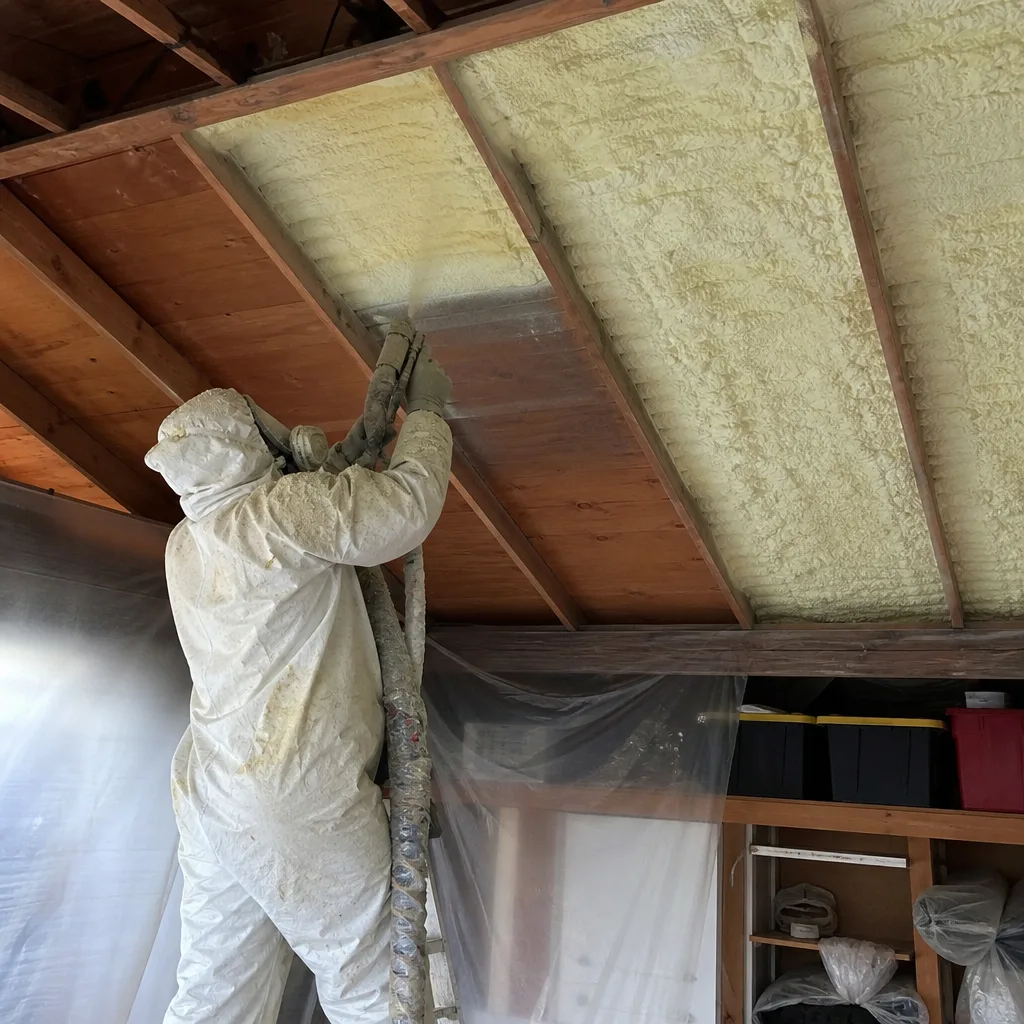
- Closed-cell spray foam maintains structural integrity and R-value far better in high heat and adds rigidity to the roofline. It’s the highest-performing option for El Monte attics if you’re conditioning the attic space itself.
- Cellulose performs well against heat transfer but can settle if installed improperly and needs a stable, dry environment to maintain its treated fire resistance.
- Rockwool stone wool is dense, dimensionally stable, and maintains its R-value consistently across temperature ranges. It also carries a Class A fire rating, which matters in El Monte’s dry season when attic temperatures make lower-temperature-rated materials a liability.
The practical takeaway: if you have a standard vented attic in El Monte, the best-performing setup is either blown cellulose at R-49 minimum or Rockwool batts layered to R-49, paired with thorough air sealing at the attic floor. If you’re converting the attic to conditioned space or have a complex roofline with HVAC equipment up there, closed-cell spray foam becomes the stronger choice. Products from Icynene and Demilec are what we stock for these applications specifically because they hold up under San Gabriel Valley heat loads.
One more El Monte-specific consideration: wildfire season. Ember protection matters, and attic venting is a known vulnerability. While insulation itself isn’t your ember defense, the air sealing and vent screening that should accompany attic insulation work can reduce entry points. That’s a conversation worth having during your energy audit.
Wall Insulation: The Overlooked Heat Path in Stucco Tract Homes
Every El Monte homeowner knows the experience of touching an interior wall on a summer evening and feeling heat radiating off it. That’s your stucco exterior absorbing solar energy all day and conducting it through the framing into your living space. Without wall insulation, that heat transfer is relentless.
The challenge with walls is that retrofitting insulation isn’t as simple as blowing material into an open attic. You have three practical options in El Monte’s wood-framed homes:
- Dense-pack cellulose through small holes: Installers drill access holes through the stucco or drywall, blow cellulose under pressure into the wall cavities, then patch and texture-match. This works well in existing 2×4 walls and achieves roughly R-13.
- Injection foam through existing walls: Slow-expanding foam fills cavities with a material that air-seals and insulates simultaneously. More expensive than cellulose but better at sealing irregular cavities and gaps around electrical boxes.
- Interior retrofit: remove drywall, insulate, reinstall: The most thorough approach and the best time to add electrical upgrades, but the highest cost and disruption.
For most El Monte homes, dense-pack cellulose is the sweet spot of cost, performance, and disruption. Wall insulation typically delivers the second-highest ROI after attic work because walls represent about 30% of the building envelope’s surface area in a single-story tract home.
We match the material to the home rather than pushing one option. CertainTeed’s dense-pack cellulose is a frequent choice for El Monte walls because it flows well in older framing, but we’ve also used Rockwool in specific walls where fire resistance or sound isolation between units matters, such as duplexes and ADUs common in El Monte’s multifamily conversions.
Crawl Space Encapsulation: The Missing Piece for El Monte Homes
Here’s a sentence most insulation guides skip entirely: if your El Monte home has a vented crawl space with a dirt floor, you can insulate your attic to R-60 and still feel floors that are warm in summer and cold in winter. Your attic, walls, and crawl space work as one system, and ignoring the bottom of the envelope leaves a significant heat path unmanaged.
Vented crawl spaces in El Monte present a specific set of problems:
- Summer heat ingress: Air at 100°F enters through foundation vents, warms the floor assembly from below, and rises through the home. Insulating the attic doesn’t touch this.
- Humidity and condensation: The San Gabriel Valley isn’t humid like Houston, but the temperature differential between outside air and the cooler crawl space still creates condensation on ductwork and floor joists in certain months.
- Duct losses: If your HVAC ducts run through the crawl space, they’re delivering conditioned air through unconditioned space. Every degree lost in the duct is a degree you paid for.
- Rodent and pest entry: Vented crawl spaces with loose screens are open doors for rodents. Once they’re in, they nest in your fiberglass, gnaw on ductwork, and leave droppings throughout the space.
- Proper attic ventilation, so the reflected heat has somewhere to go
- R-49 attic floor insulation, so the remaining conducted heat is slowed
- Sealed ductwork, so the cooler attic air isn’t wasted on leaky ducts
- Reducing peak afternoon cooling load: Every BTU you keep out of the home is a BTU your AC doesn’t have to remove. Given that El Monte’s peak cooling demand aligns with SCE’s on-peak pricing windows, heat-gain reduction saves money at the most expensive marginal rate.
- Flattening your daily load curve: A well-insulated home stays cooler longer after the AC cycles off, delaying the next compressor start and shifting cooling demand toward evening hours when rates drop.
- Resisting overnight heat re-entry: During heat waves, El Monte’s overnight lows occasionally fail to drop below 80°F. A properly insulated and sealed envelope keeps that exterior heat from re-entering the home while you’re trying to recover indoor temperatures.
Crawl space encapsulation in El Monte typically involves sealing the foundation vents, laying a reinforced Class I vapor barrier across the floor and up the foundation walls, sealing the rim joist area with spray foam, and optionally adding a dehumidifier or conditioning supply. The result is a crawl space that no longer fights your home’s insulation. In our experience, homes that complete encapsulation as part of a full-envelope project see the biggest single-season change in both comfort and energy cost of any improvement we make.
Radiant Barrier: The Most Underused Tool for San Gabriel Valley Heat
Insulation slows conductive and convective heat transfer. Radiant barrier addresses something different: radiant heat transfer. In El Monte’s climate, radiant heat is the dominant mode of heat gain in summer. When your roof deck hits 160°F, it’s radiating infrared energy directly down onto your insulation. That insulation slows the transfer, but it doesn’t stop the radiation from loading heat into the attic air and the top surface of your ceiling.
A radiant barrier stapled to the underside of your roof rafters reflects a large percentage of that infrared energy back toward the roof deck. Studies by the Department of Energy and Oak Ridge National Laboratory show that radiant barriers in hot climates can reduce attic temperatures by 20 to 35°F and cut summer cooling loads by 5 to 10% in homes with ductwork in the attic. Those numbers aren’t theoretical. They’re measured in climates similar to El Monte’s.
Radiant barrier works best when paired with:
If your HVAC equipment and ductwork live in the attic, radiant barrier is close to a no-brainer in El Monte. The temperature drop it creates in the attic directly reduces the thermal stress on your ducts and the air handler, which translates to lower cooling costs and longer equipment life. We include radiant barrier as a standard recommendation in our home energy audits when the roof orientation and attic configuration support it.
How SCE’s Tiered Rates Make Heat-Gain Reduction Your Best ROI
Southern California Edison’s residential rate structure for El Monte homes is tiered, meaning the marginal cost per kilowatt-hour rises as you use more electricity. As of the current rate schedules, SCE’s Tier 2 rates run significantly higher than Tier 1, and homes with air conditioning in the San Gabriel Valley routinely push into the higher tiers from June through September.
This changes the insulation math compared to what you’d read in a national guide. In a heating-dominated climate, insulation ROI comes from reducing winter heating fuel. In El Monte, your insulation ROI comes from three specific mechanisms:
What does this mean in practical dollars? A 1950s El Monte tract home with no wall insulation, R-11 attic insulation, and a vented crawl space might use 40 to 60% more electricity for cooling than the same home after a full-envelope upgrade. At SCE’s tiered rates, that difference isn’t linear. The savings concentrate at the most expensive tier, which is exactly where you want them.
What Does Insulation Cost in El Monte?
Pricing in El Monte tracks the specifics of your home’s construction, current condition, and the materials your project calls for — see our Insulation Cost Breakdown: The El Monte Homeowner’s Reference for 2026 for detailed context. Here are ballpark ranges for common projects in El Monte’s housing stock, based on what we quote daily:
- Attic air sealing plus blown cellulose to R-49: $1.50 to $2.50 per square foot of attic floor, including removal of deteriorated existing insulation when needed. For a 1,200-square-foot attic, expect $1,800 to $3,000.
- Dense-pack wall insulation for an existing 1,500-square-foot stucco home: $1.50 to $2.75 per square foot of wall area, depending on access, existing insulation removal, and patch requirements. Typical budget: $2,500 to $4,500.
- Crawl space encapsulation with Class I vapor barrier, vent sealing, and rim joist air sealing: $2,500 to $6,000 depending on crawl space size, access clearance, drainage conditions, and whether rodent exclusion is required.
- Radiant barrier installation on roof rafters: $0.75 to $1.50 per square foot of rafter area. Typical 1,200-square-foot attic: $900 to $1,800.
- Closed-cell spray foam for attic roofline or specific high-performance applications: $2.50 to $4.50 per square foot, depending on thickness and product line (Icynene and Demilec products fall in this range).
Material choice shifts these numbers significantly. Fiberglass batt or cellulose is the cost-effective workhorse for most El Monte attics. Rockwool adds 20 to 40% to material cost but brings fire resistance and sound attenuation that matter in specific situations, such as attached dwellings or homes near commercial corridors. Spray foam, especially closed-cell, is the premium option reserved for cases where air sealing and structural performance justify the cost.
The most common pricing mistake we see El Monte homeowners make is comparing quotes without comparing scopes. A $1,200 “attic insulation” quote that doesn’t include air sealing, removal of old material, or rodent proofing isn’t cheaper. It’s a smaller job that leaves the thermal leaks in place. When you compare quotes, insist on line items.
Common Mistakes to Avoid
- Insulating without air sealing first: Blowing fresh insulation over leaky top plates and unsealed penetrations is like wearing a down jacket with the zipper open. Seal first, then insulate. In El Monte’s climate, unsealed air leakage can cut effective insulation performance by 30% or more.
- Quoting R-value without checking the climate zone: A contractor who recommends R-38 for a vented El Monte attic is quoting you a coastal standard. Title 24 Zone 10 requires R-49. If the quote doesn’t mention Zone 10, ask why.
- Ignoring the crawl space: In El Monte homes with vented crawl spaces, the floor assembly is an uninsulated surface exchanging heat with outside air all day. Attic work alone leaves this pathway fully open.
- Using open-cell foam in a superheated attic: Open-cell underperforms at the temperatures El Monte attics reach. If spray foam is the right call for your home, closed-cell will hold up better.
- Skipping rodent proofing before blowing new insulation: El Monte’s older neighborhoods have established rodent populations. If you don’t address entry points before installing new material, you’ll be replacing it within two years.
- Letting one brand drive the recommendation: A contractor locked into one manufacturer will match your home to their product. The homeowner-friendly approach is matching the product to the home from a multi-brand library.
- Treating insulation as a one-product purchase: Your attic, walls, and crawl space work as one system. Fixing one zone in isolation delivers partial results and guarantees you’ll revisit the envelope later.
When to Call a Professional
Some insulation projects are genuinely DIY-friendly, like rolling unfaced fiberglass batts across an open, flat attic floor. Most of what El Monte’s housing stock actually needs is not — read our DIY vs Professional Insulation: The El Monte Homeowner’s Decision Guide to understand why. Air sealing requires identifying and addressing dozens of small penetrations properly. Blown-in insulation requires equipment and technique. Wall retrofits require drilling, patching, and understanding framing. Crawl space encapsulation involves moisture management decisions that can cause structural problems if done wrong. And spray foam installation is a professional application, full stop. If your home predates 1980 and you’re serious about energy performance, start with a home energy audit rather than a ladder and a trip to the hardware store. Pacific Insulation El Monte offers free estimates in El Monte — call (626) 254-6177 and we’ll assess your attic, walls, and crawl space before you spend a dollar on materials.
Frequently Asked Questions
Your El Monte attic needs R-49 insulation minimum if it’s a vented attic, per California’s Title 24 requirements for Climate Zone 10. Older El Monte homes often have R-11 to R-19, which means most homeowners need to roughly double or triple their existing attic insulation. Call (626) 254-6177 for a free attic assessment and an exact scope for your home.
In most El Monte homes built before 1980, replacement is the better financial decision. Old fiberglass that’s compressed, rodent-damaged, or settled below R-19 isn’t worth trying to repair; removal and fresh installation to R-49 delivers the energy savings that pay for the project. If your insulation is in decent shape but insufficient, adding a layer on top may work. A free inspection will tell you which path applies.
Yes, radiant barrier is one of the highest-ROI upgrades for El Monte because the climate is dominated by radiant heat gain, not winter cold. Stapled to the underside of roof rafters, it can reduce attic temperatures by 20 to 35°F and cut summer cooling loads 5 to 10% when combined with R-49 floor insulation. Homes with attic ductwork benefit most.
Crawl space encapsulation in El Monte typically costs between $2,500 and $6,000 depending on crawl space size, access clearance, drainage conditions, and whether rodent exclusion and rim joist air sealing are included. It’s usually bundled with attic work for a full-envelope project. Call (626) 254-6177 for a specific quote; estimates are free.
Yes, dense-pack cellulose and injection foam can both be installed through small access holes drilled from the exterior or interior, then patched and color-matched. This is the standard approach for El Monte’s stucco tract homes, where full drywall removal would be unnecessarily disruptive. The process takes one to two days for a typical single-story home.
For a typical 1,200 to 1,500-square-foot El Monte home, a full attic air sealing, insulation upgrade, and crawl space encapsulation project runs two to three working days with a single crew. Wall insulation adds one to two days depending on access and patching requirements. Rodent proofing and attic cleaning, when needed, happen before insulation and add a day.
The Bottom Line
El Monte’s insulation needs are defined by three things: a climate zone that demands R-49 attics and heat-gain resistance, a housing stock from the 1950s through 1970s with walls that were never insulated and attics that have degraded, and an SCE rate structure that makes cutting peak cooling demand the most valuable energy improvement you can make. The right approach isn’t a single product. It’s a diagnosis of the whole thermal envelope followed by air sealing, targeted insulation by material and location, and crawl space work where the home sits above a vented cavity. Start with a home energy audit, get line-item quotes that reference Zone 10 requirements, and don’t let anyone sell you a coastal solution for an inland climate. Pacific Insulation El Monte home is your starting point. For specifics on materials and methods, see our guides on spray foam insulation in El Monte and blown-in insulation in El Monte.
Written by the team at Pacific Insulation El Monte, serving El Monte since 2016. Explore more guides & resources for El Monte homeowners.