
Last updated September 16, 2026
Insulation Warning Signs: A El Monte Homeowner’s Reference Guide
If your bedroom is 6°F hotter than your living room at 9 PM in August, that’s not an HVAC problem. It’s almost certainly a wall or ceiling insulation gap that your air conditioner is fighting and losing against, and adding refrigerant won’t fix it. This complete guide to insulation in El Monte maps the household symptoms you’re already living with back to their physical causes in your attic, walls, and crawl space. By the time you finish reading, you’ll know what a $50 SCE bill spike means differently in June than it does in January, how to use a $15 infrared thermometer to find failing insulation in El Monte, and which stains and smells point to insulation problems versus roofing or plumbing failures. You’ll also know when a symptom is urgent enough that waiting another season will cost you real money.
Quick Answer
The most common insulation warning signs in El Monte homes are room-to-room temperature differences of more than 3-4°F, summer electricity bills that spike regardless of thermostat settings, visible or damaged attic insulation, musty odors that don’t clear with HVAC filter changes, and moisture stains on ceilings with no obvious roof leak. Any single sign suggests an insulation or air sealing deficiency somewhere in your thermal envelope; our Attic Insulation Maintenance Checklist for El Monte Homeowners can help you track these. Two or more signs together mean you’re losing conditioned air through multiple zones and should have a home energy audit performed before spending money on mechanical repairs.
Table of Contents
- The Room-Temperature Differential Diagnostic
- Decoding Your SCE Bill: Summer vs. Winter Spikes
- Visible Signs in El Monte’s Housing Stock
- Odor and Air Quality Signals
- The Moisture Stain Decision Tree
- Attic Ventilation Problems That Mimic Insulation Failure
- Common Mistakes to Avoid
- When to Call a Professional
- Frequently Asked Questions
The Room-Temperature Differential Diagnostic
Every El Monte summer, we get calls from homeowners convinced their central air system is failing because one bedroom won’t cool below 80°F while the hallway sits at 74°F. More often than not, the HVAC equipment is doing exactly what it was sized to do. The problem is that the room itself is bleeding conditioned air through an under-insulated wall cavity or ceiling, and the heat load coming through that surface outpaces what the supply register can deliver.
Here’s how to map the problem yourself with a $15 infrared thermometer from any hardware store:
- Set your thermostat to 75°F and let the house stabilize for two hours. You want steady-state conditions, not the temperature swings that happen right after the system cycles.
- At 3-4 PM on a hot day, shoot the center of each room’s ceiling and record the reading. Then shoot the center of each room’s exterior-facing wall, about five feet up from the floor. Write down every number.
- Compare readings room to room. A difference of more than 3-4°F between comparable surfaces (two south-facing bedroom ceilings, for instance) points to a specific insulation deficiency rather than a housewide issue.
- Pay attention to which walls read hot. In El Monte homes built before 1978, west-facing walls take the hardest late-afternoon heat load. If the wall surface reads 84°F while the room air is 75°F, that wall is conducting heat straight into the living space. The cavity insulation has either settled, compressed, or was never adequate in the first place.
- Check the ceiling temperature directly above rooms you know get hot. An attic floor with thin or displaced insulation will read 90°F or higher on the ceiling while a properly insulated section reads 78-80°F under identical roof conditions.
What you’re doing here is diagnosing the thermal envelope before you call anyone. This matters because the person who shows up with a quote for a bigger AC unit isn’t asking the right questions. The right question is where conditioned air is escaping, and a temperature map answers it with data. In our experience as an Attic Insulation in El Monte contractor, roughly seven out of ten “undersized AC” complaints trace back to insulation and air sealing failures that were present before the original system was installed.
Decoding Your SCE Bill: Summer vs. Winter Spikes
Southern California Edison bills don’t tell you where you’re losing energy, but the timing and shape of a spike tells you a lot. A $50-per-month jump between your May and June bills means something different than the same jump between December and January, and the difference is diagnostic.
A summer bill spike in El Monte points to one of three insulation conditions:
- Attic heat transfer. On a 95°F day, the air in an uninsulated or poorly insulated attic can exceed 130°F. That heat radiates down through the ceiling drywall into your living space all afternoon, keeping your AC cycling even after the outdoor temperature drops. If your system runs from 3 PM to midnight in August, that’s not an air conditioner problem. That’s a thermal boundary problem.
- West wall heat gain. If your summer spike is worst between 4 PM and 8 PM, suspect wall cavities on the west side of the house. This is a common pattern in El Monte’s stucco tract homes where the original wall insulation was minimal. The stucco radiates absorbed heat into the wall cavity for hours after sunset, and that heat migrates inward.
- Air leakage into the attic. Supply ducts run through the attic in most El Monte homes. When can lights, ceiling penetrations, or the attic hatch aren’t sealed, conditioned air from the house gets pulled into the attic by the stack effect and the AC works harder to replace it. On the bill, this looks identical to heat gain, but the physical cause is air movement, not conduction.
A winter spike, by contrast, usually signals air leakage through the floor into the crawl space, a missing or failed vapor barrier, or wall cavities with zero insulation where cold air drives convective loops. The fix there might be Spray Foam Insulation in El Monte on rim joists and floor assemblies, depending on what an energy audit finds. The key point: before you approve any insulation work, sit down with twelve months of SCE statements. The seasonal shape of your usage tells us which zone we should inspect first.
Visible Signs in El Monte’s Housing Stock
El Monte’s housing stock spans roughly seventy years of construction methods and materials, and each era fails in its own way. If you can see the insulation, you can often read the problem directly.
In homes built in the 1950s and 1960s, you’ll typically find fiberglass batts in the attic and wall cavities. These batts are now sixty to seventy years old. We’ve pulled batts out of El Monte attics that looked like yellowed, brittle paper that crumbled on contact. What homeowners don’t realize is that fiberglass loses thermal performance through compression, moisture intrusion, and sheer age. A batt that was R-19 when it was installed in 1962 is doing R-9 to R-11 of real-world work today. That’s a 40-60% loss, and it happens silently, throughout the attic, year after year.
Signs you can see with your own eyes, listed in the order you should check:
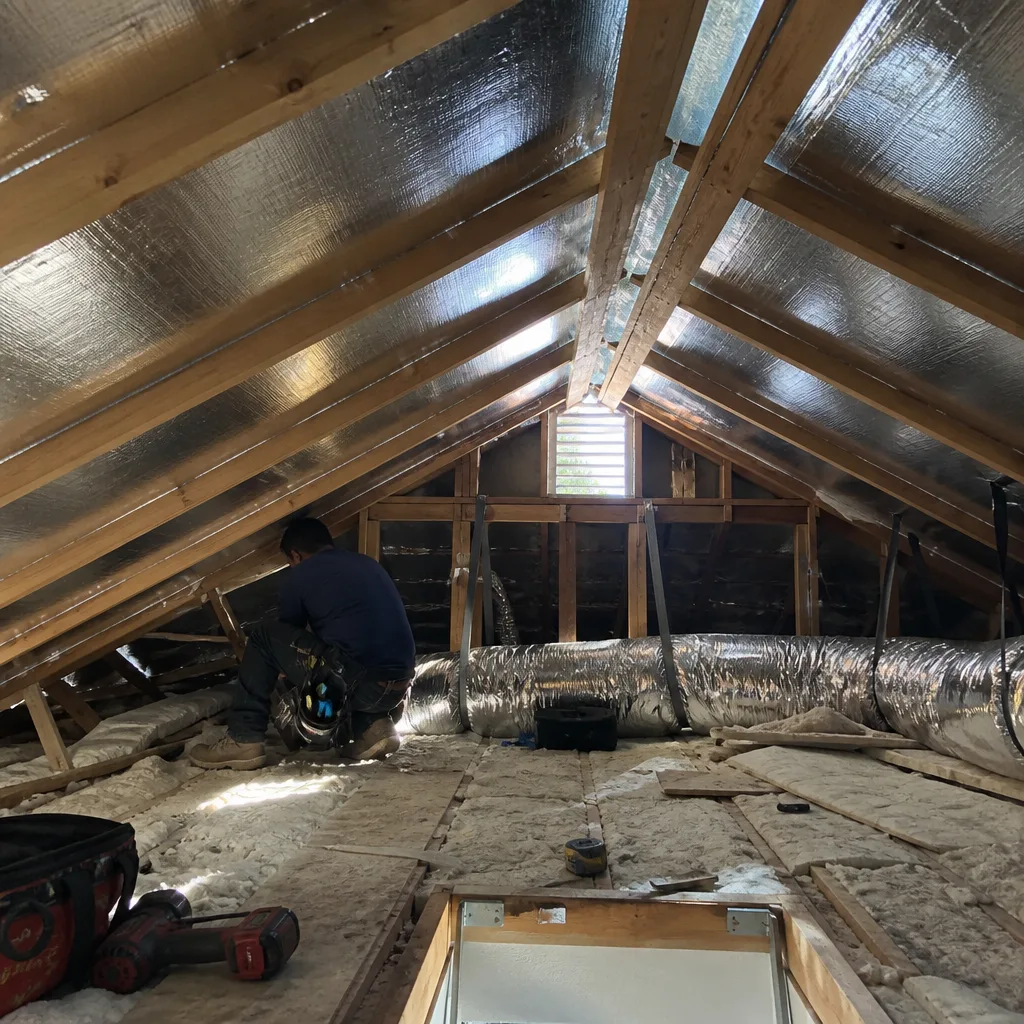
- Compressed or flattened batts anywhere in the attic, particularly under walkways, storage boxes, or areas where the roof pitch flattens. Compression kills the air pockets that do the insulating.
- Dark, dirty insulation. Fiberglass that looks gray-black has been filtering air through itself for years. Every dark patch marks an air leak path, and the insulation in those spots is doing almost nothing.
- Insulation that slopes or piles unevenly. This usually means someone moved it aside for electrical or cable work and never put it back, or rodent activity has redistributed it.
- Exposed ceiling joists. If the top edges of your attic floor joists are visible above the insulation, your coverage is too thin. In El Monte’s climate zone, the Department of Energy recommends R-30 to R-60 in attics depending on the existing insulation type, and most older El Monte homes are nowhere near that.
- Wall cavities visible from the garage. Many El Monte tract homes have an attached garage where the wall between garage and house was never insulated. If you can see bare wall studs from the garage side, the house side of that wall is usually uninsulated too.
What this means practically is that older El Monte homes don’t just benefit from adding insulation on top of what’s there. They benefit from removing the degraded material first, air sealing the attic floor, and then installing new material matched to the specific house. If you’re seeing any of these signs in your attic, start with Blown-In Insulation in El Monte as a replacement option after removal, but don’t skip the air sealing step. New insulation over old leaks is a half-fix.
Odor and Air Quality Signals
Insulation doesn’t just fail thermally. It fails biologically and chemically, and the evidence ends up in the air you breathe. El Monte’s warm, dry summers and cool, damp winters create the conditions for several insulation-related air quality problems that homeowners misdiagnose as HVAC issues; see our Seasonal Insulation Care for El Monte: Year-Round Homeowner’s Guide for prevention tips.
Musty attic smell that drifts down into the house. When insulation gets damp, it holds that moisture against the ceiling drywall and wooden framing. The odor source isn’t in your living room; it’s above your head, moving down through ceiling penetrations. Fiberglass batts can hold moisture for months after a roof leak is repaired, and that moisture breeds mold inside the insulation itself, where you can’t see it without pulling the material up. If you smell mustiness in rooms that share a ceiling with the attic and the smell gets worse in the evening when the attic air cools and sinks, you’re smelling your insulation.
Dust accumulation around supply registers. Every supply register in your house has a margin where air exits. If you notice dark, fuzzy dust accumulating around specific registers, especially registers closest to the attic access, that dust is frequently insulation fibers being pulled into the duct system through unsealed joints in the attic. This matters because blown-in insulation particles and fiberglass fibers aren’t something you want circulating in bedroom air. The primary fix is air sealing the duct connections and the supply boots to the drywall.
Allergy flare-ups that don’t respond to filter changes. If you’ve swapped your HVAC filter for a fresh one and allergy symptoms persist or worsen in specific rooms, consider what’s in the wall cavities and attic above those rooms. Rodent-contaminated insulation is the most common culprit we encounter in El Monte. Rats and mice nest in insulation, leave urine and droppings throughout it, and the particles become airborne through the same air leaks that are costing you money. This is also when removal becomes a health issue, not just an efficiency issue. The insulation in affected zones needs to come out, the space needs to be cleaned and rodent-proofed, and only then should new insulation go in. Our Pacific Insulation El Monte home services include attic cleaning and rodent proofing for exactly this sequence, so one crew handles the problem from contamination to new insulation without a separate pest contractor.
Here’s a simple decision filter: if the smell or symptom changes when your HVAC system runs, check the HVAC. If it’s constant regardless of system operation and worse near certain walls or ceilings, it’s the insulation or the building envelope, not the mechanical system.
The Moisture Stain Decision Tree
You find a brownish stain on a bedroom ceiling. It could be a roof leak, a plumbing leak, or condensation from an insulation deficiency. Calling the wrong contractor means paying for a diagnosis that doesn’t solve the problem. Here’s the decision tree we walk homeowners through, and it’s easier than you’d think.
- Check if the stain is directly under a roof penetration or valley. Skylights, vent pipes, plumbing stacks, and roof valleys are classic roof leak points. If the stain is within a few feet of one of these on the underside, roof leak goes to the top of the list. Call a roofer first.
- Check if the stain is under a bathroom or water line. If the stain is below a bathroom, water heater, or any plumbing run, and it grows after showers or water use, call a plumber first. This isn’t insulation-related at all.
- Check the shape and borders of the stain. Roof and plumbing leaks produce irregular stains with a clear source point and spreading pattern. Condensation stains from poor insulation and air sealing tend to be diffuse, ring-shaped, or pattern-like, often forming in a circle around a ceiling register, a recessed light, or following the line of the ceiling joists. That’s moisture condensing on cold drywall where warm, moist indoor air meets a cold ceiling surface.
- Check when the stain appears. A condensation stain appears and worsens during cold damp weather, especially in the morning after a cold El Monte winter night when the attic is cold and the house is heated. A roof leak stain appears during and after rain regardless of temperature.
- Check the attic above the stain. If you can get into the attic safely, look directly above the stain with a flashlight. Feel the insulation. If it’s damp, compressed, or smells musty, you’re looking at the source. If the insulation has a dry crust on top but wet material underneath, that’s condensation migrating down through the insulation and condensing on the ceiling plane. The insulation in that area needs replacement and the ceiling needs air sealing.
Here’s the practical rule: roof leaks are punctual and weather-linked. Plumbing leaks are usage-linked. Condensation stains are thermal and seasonal. If your stain is round, seasonal, and follows the ceiling joists in a room that’s also hard to heat or cool, your problem is insulation and air sealing, not roofing or plumbing. Treating that stain with a roof patch is wasted money. Sealing the ceiling penetrations and restoring the insulation in that zone is the fix.
Attic Ventilation Problems That Mimic Insulation Failure
Some of the symptoms we’ve described can also be caused by attic ventilation failures, and the two get confused constantly. It matters because the fix is different, and in some El Monte homes you need both corrected for the insulation to perform.
An attic with soffit vents that have been painted over, blocked by debris, or improperly installed creates a heat trap. The attic can reach 140°F or more in August, which overwhelms whatever insulation is on the attic floor by radiating heat downward. The insulation isn’t failing; the attic can’t breathe, and no amount of added insulation will solve a ventilation problem by itself. The classic sign is an attic that’s dramatically hotter than the outdoor air even late at night, and ceilings that stay warm to the touch well after sunset.
Conversely, an attic with excessive upper ventilation and no lower intake can pull conditioned air out of the living space through every ceiling penetration, a condition called reverse stack effect. You’ll see the SCE bill spike but the attic insulation looks fine. The fix is balancing the attic ventilation system and air sealing the ceiling plane, which is a standard part of a thorough energy audit.
The takeaway: if your symptoms point to insulation but the insulation looks intact, look at the attic ventilation system before replacing anything. A home energy audit with a blower door test will show exactly how many air changes per hour your house is experiencing and where the major leakage points are. That’s information no visual inspection can give you, and it’s why we start every El Monte project with the diagnostic rather than the sales pitch.
Common Mistakes to Avoid
- Adding refrigerant before checking the thermal envelope. If one room won’t cool while others do, the unit isn’t low on refrigerant; the room is leaking conditioned air. Ask your HVAC technician to check insulation in the offending room before topping off refrigerant.
- Adding new insulation on top of rodent-contaminated or water-damaged material. New insulation over contaminated material seals in the problem and lets it keep deteriorating out of sight. Removal comes first, then air sealing, then new insulation.
- Using batt insulation in areas that need air sealing. A batt stapled into a wall cavity doesn’t stop air movement. Without air sealing the top and bottom plates, the cavities leak regardless of what insulation is in them.
- Choosing insulation based on price per square foot. The cheapest quote ignores removal, air sealing, vapor management, and access costs. In El Monte, where attic access hatches are often small and roof pitches vary by tract, the real cost includes the prep work, not just the material.
- Ignoring the crawl space when diagnosing cold floors. Homes in south El Monte neighborhoods with vented crawl spaces lose heat through the floor all winter. If your feet are freezing in December and the thermostat says 72°F, the problem is below you, not above you.
- Treating moisture stains with paint or stain-blocking primer. Painting over a condensation stain without fixing the thermal defect is a temporary cosmetic fix. The stain returns, and by the time it does, mold may be growing in the insulation above it.
- Waiting to replace insulation until it “fails completely.” Insulation degrades gradually. By the time it’s visibly collapsed or visibly wet, you’ve already paid for years of excess energy consumption. The right time to evaluate is when symptoms first appear, not when the material looks destroyed.
When to Call a Professional
If your room-temperature map shows more than a 4°F difference between comparable surfaces, if your SCE summer bill has crept up without a change in thermostat behavior, or if you can see dark, compressed, or wet insulation in your attic, call someone who diagnoses before they quote. You want a contractor who will walk the attic with you, show you the problem, and explain the sequence of fixes before any money changes hands. Pacific Insulation El Monte offers free estimates in El Monte and starts every project with a home energy audit, not a product pitch. Call (626) 254-6177 to schedule a walkthrough. We’ll show you exactly what’s happening in your attic, walls, and crawl space, and we’ll match the material to your home rather than pushing a single brand.
Frequently Asked Questions
Your insulation is failing if you have room-to-room temperature differences over 3-4°F, unusually high summer electric bills, cold floors in winter, or visible damage in the attic like compressed, dark, or wet material. Any of these signs justifies an inspection, and two or more together usually mean multiple zones need work.
Ceilings that feel warm to the touch in summer, rooms under the attic that won’t hold temperature, musty smells drifting down from above, and attic insulation that looks flattened, dark in patches, or has exposed joists are the main signs. In El Monte’s older homes, insulation installed in the 1960s has often lost half its rated R-value, even if it visually looks “okay.”
Insulation replacement in El Monte typically runs between $1,500 and $4,500 for an average attic, depending on the square footage, the condition of the existing material, access difficulty, and whether air sealing and rodent proofing are included. Whole-house projects including walls and crawl space run higher. Call (626) 254-6177 for a specific quote on your home; estimates are free.
Yes, especially when the insulation is old, degraded, or rodent-contaminated. Air leaking through the attic and wall cavities pulls insulation particles into the living space, where they settle around supply registers and on surfaces. If dust appears faster than your HVAC filter can handle, the insulation and the air sealing above it are typically the source.
Yes, and it’s usually the highest-ROI energy improvement you can make in an older El Monte home. The combination of degraded original insulation, air leaks around ceiling penetrations, and the valley heat load means that attic insulation and air sealing frequently cut summer cooling bills by 15-25%. Homeowners also report more even temperatures between rooms, which no mechanical fix can deliver.
A roof leak stain is irregular and tied to rainfall. An insulation or condensation problem produces round or ring-shaped stains that follow ceiling joists and appear during cold weather, especially around recessed lights and registers. If the stain’s shape is geometric and predictable, think insulation before roofing.
The Bottom Line
Most insulation failures in El Monte homes announce themselves through symptoms you’re already living with: the hot bedroom, the climbing SCE bill, the musty smell you’ve stopped noticing, the stain you’ve painted over twice. Those symptoms are data. They point to specific zones: the attic over the west bedrooms, the wall cavities with the afternoon sun, the ceiling plane that leaks air into a 130°F attic. The diagnostic is cheap, the fix order matters, and the wrong sequence removes any savings you’d otherwise capture. Start with an energy audit, read your bill history, map your temperatures, and call someone who does the work themselves, or explore more guides & resources to prepare. One crew, one diagnosis, one accountable pair of hands. That’s the difference between a fix that lasts and a quote that disappears after the first warm week.
Written by the team at Pacific Insulation El Monte, serving El Monte since 2016.