
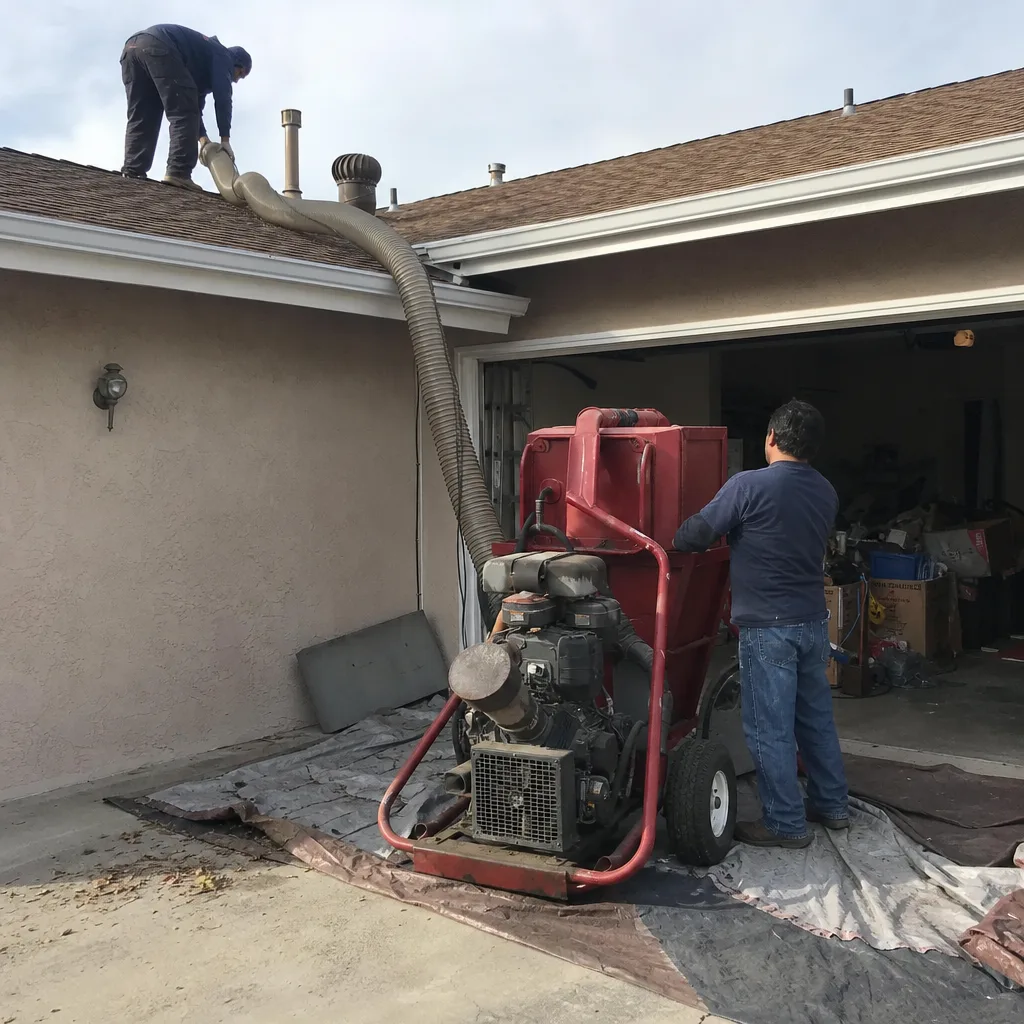
Last updated September 16, 2026
Seasonal Insulation Care for El Monte: Year-Round Homeowner’s Guide
February is the month El Monte homeowners discover their insulation has a moisture problem. Not because it rains hard, but because 55-degree nights plus poorly sealed attic bypasses create exactly the dew-point conditions that grow mold inside fiberglass batts without any visible leak. By the time you notice the musty smell drifting down from the hatch, the damage has been working quietly for weeks. This guide walks you through what actually happens to insulation in El Monte’s climate across the year, when to inspect, what to look for, and when the right move is repair versus replacement. For a deeper dive, see our The Complete Guide to Insulation in El Monte.
Quick Answer
Seasonal insulation care in El Monte means checking your attic, ducts, and crawl space at four specific times each year: spring (pest nesting), early summer (radiant barrier and duct wrap), fall (Santa Ana wind displacement), and winter (moisture from attic bypasses). For a detailed checklist, see our Attic Insulation Maintenance Checklist for El Monte Homeowners. Most issues are preventable with a May inspection and an October inspection. If you do both, your insulation will last decades instead of failing in eight to ten years.
Table of Contents
- Why El Monte’s Climate Punishes Insulation Differently
- May-June: The Pre-Summer Heat Protocol
- July-September: Surviving the Radiant Heat Assault
- October-November: The Santa Ana Wind Checklist
- December-February: The Deceptive Moisture Season
- March-April: Pest Pressure and Nesting Season
- How to Build a One-Page Annual Insulation Log
- Common Mistakes to Avoid
- When to Call a Professional
- Frequently Asked Questions
- The Bottom Line
Why El Monte’s Climate Punishes Insulation Differently
El Monte sits in the San Gabriel Valley, where summer temperatures routinely push into the mid-90s and Santa Ana winds arrive with the kind of dry, high-velocity force that moves lightweight material around inside attic spaces. The city doesn’t get the coastal marine layer that tempers Long Beach or the mountain cold that hits Big Bear. What it gets is sustained heat loading from May through October, punctuated by wind events that create pressure differentials most insulation was never designed to handle.
But the real problem is what happens between those extremes. El Monte’s winter is mild by national standards, which sounds good until you understand dew point. When interior air at 68 degrees with 45 percent relative humidity meets a 50-degree attic surface, condensation forms. It doesn’t need to be freezing outside. It doesn’t need to be raining. It just needs warm, humid air touching a cool surface. And in El Monte, that happens every winter night.
This is why treating insulation as a set-it-and-forget-it investment fails here. The material itself degrades from UV exposure in summer, wind displacement in fall, moisture absorption in winter, and pest activity in spring. Four distinct stress periods, each requiring a different kind of attention. We’ve worked on attics across the San Gabriel Valley, and the pattern is consistent: homes with seasonal inspection habits keep their insulation performing for 20-plus years, while homes with no inspection schedule hit thermal failure in under a decade. The difference isn’t the material. It’s the attention.
Understanding this cycle before you spend money on insulation matters. A homeowner who knows that batt settling happens most in fall wind season won’t panic when they see uneven coverage in November. A homeowner who knows that fiberglass holds moisture differently than closed-cell spray foam won’t assume every damp spot means replacement. Knowledge changes what you buy and when you act.
May-June: The Pre-Summer Heat Protocol
The single most valuable insulation inspection of the year happens in May, before the first sustained heat wave. Here’s why: every problem that reduces insulation performance in August is visible and correctable in May. Once daytime highs settle in the low 80s and the AC starts cycling daily, the attic becomes a place you don’t want to enter until late September. You have roughly a six-week window, from mid-May through late June, when attic temperatures are still manageable and you can catch problems while they’re cheap to fix.
Start with the three-point pre-summer checklist:
- Verify radiant barrier reflectivity. If you have a radiant barrier stapled to the underside of your rafters, dust accumulation degrades its reflectivity. In El Monte’s dry summer, attic dust is nearly constant. A barrier covered in a thin layer of gray dust reflects maybe 60 percent of what a clean barrier reflects. Wiping it down with a dry microfiber cloth, or having it inspected during a routine service call, restores the performance you’re paying for. This matters because your radiant barrier is doing a lot of the work of keeping your attic from turning into a 130-degree oven.
- Check duct wrap integrity. Your ductwork runs through the hottest part of your house. If the fiberglass wrap around those ducts has gaps, tears, or sections that have slipped, conditioned air is being heated before it reaches your vents. In El Monte summer, uninsulated ducts can lose 30 percent of their cooling capacity. Run your hand along accessible duct runs. If you feel cold air escaping or see sections of duct where the wrap is missing, that’s a repair to schedule before July.
- Top off settled blown insulation. Loose-fill fiberglass and cellulose settle over time. In El Monte’s dry climate, settling happens faster than in humid regions because the material dries out and compresses. If your attic has 12 inches of blown insulation but the original install was 16, you’ve already lost measurable R-value. R-38 blown insulation that settles to 10 inches is performing closer to R-29. May is the time to have it topped off, before the heat season makes attic work miserable and before you pay a full summer of higher cooling bills for insulation that isn’t doing its job.
At Pacific Insulation, we start with a home energy audit when clients report high summer bills but aren’t sure which part of their envelope is failing. The audit tells you whether your attic insulation is underperforming, whether your ductwork is leaking conditioned air, or whether air sealing is the real culprit. It’s the difference between guessing and knowing, and it’s the step that prevents homeowners from buying new insulation when they actually needed their ducts wrapped.
July-September: Surviving the Radiant Heat Assault
Once El Monte hits its stride in late July, the attic becomes the most hostile environment in your house. Roof deck temperatures climb to 140 degrees and higher. Radiant heat transfers through the roof sheathing into the attic air, and whatever insulation sits between that attic and your living space is the only thing preventing your AC from running nonstop. If your insulation was properly inspected in May, this season is mostly about passive monitoring. But there are still things to watch.
Air conditioning condensation is the overlooked variable. When your AC runs hard through July and August, the evaporator coil produces gallons of condensation daily. If that condensate line is clear and sloped correctly, the water drains outside. If it’s partially clogged or cracked, water pools in the drip pan or drips onto insulation below. In El Monte’s dry heat, a small leak evaporates quickly, which sounds good until you remember that the evaporation leaves behind minerals, and the initial moisture was enough to start degrading fiberglass batt facing or promoting mold in cellulose. Once a month during heat season, check the area around your air handler for any sign of moisture staining. It takes ten minutes and catches a leak before it becomes an insulation replacement project.
In our experience, one of the most common July calls we field is from homeowners whose attics are hot enough to make their bedroom ceilings warm to the touch in the afternoon. That’s almost always a ventilation or insulation-depth problem, not an AC problem. If your ceiling is warm at 4 pm, the heat has already saturated your insulation. Adding ceiling fans won’t fix it. Lowering the thermostat won’t fix it. The fix is verifying that your attic insulation depth is adequate for El Monte’s heat load and that your attic ventilation is moving that hot air out. A properly vented attic will run about 15 to 20 degrees above outside temperature. If your attic is 30 degrees hotter than the ambient air, you’ve got a ventilation deficiency, and no amount of extra insulation is going to fully compensate.
Radiant barrier is the most effective material for this specific problem, which is why it’s a core part of our full-envelope approach. When we install it, we’re not just stapling foil to rafters, we’re creating a reflective plane that sends radiant heat back toward the roof deck instead of letting it radiate into your attic air. In El Monte’s July conditions, a properly installed radiant barrier can drop attic temperatures by 20 to 30 degrees. That’s the difference between your insulation fighting a 110-degree attic and a 135-degree one.
October-November: The Santa Ana Wind Checklist
Santa Ana winds hit El Monte with a specific signature: warm, dry, and fast, with gusts that can exceed 40 mph through the San Gabriel Valley. For your insulation, the damage isn’t visible from the street. It happens inside your attic, where wind-driven pressure differences create suction at eave vents and gable vents. Lightweight blown insulation near those openings gets displaced. It gets pushed back from the eaves, creating bare spots where the ceiling below has no protection at all.
This is a larger problem than most homeowners realize. The perimeter of your attic, the two to three feet nearest the eaves, is exactly where your exterior walls meet your ceiling. That’s where heat loss and heat gain are highest. It’s also where Santa Ana winds do the most displacement damage. If blown-in fiberglass has been pushed back 18 inches from the eave vents by October winds, you now have a thermal hole around the entire perimeter of your house.
Here’s the October checklist for wind-related insulation damage:
- Check eave baffles. Your eave vents should be protected by baffles, those foam or cardboard channels that hold insulation back from the vent while allowing airflow. If baffles are missing, dislodged, or undersized, blown insulation gets blown away from the vents every time wind pressure increases. Replace or reinstall baffles before topping off displaced insulation.
- Look for wind-driven dust and debris. Santa Ana events carry particulate matter. In El Monte, dust from the San Gabriel River wash and construction sites throughout the Valley gets driven into attics through any gap. If you’re seeing a layer of dust on top of your insulation in November that wasn’t there in September, your attic has exterior air leaks. Those same leaks drive pressure imbalances that displace insulation and force conditioned air out of your living space.
- Verify batt placement. Fiberglass batts don’t blow away, but they do shift. If batts are installed between ceiling joists and something disturbs them, whether it’s a cable installer crawling through or wind movement through the attic, they can get pushed out of position. A batt that’s shifted six inches leaves a six-inch thermal gap. October is the time to walk the attic and check that every batt is sitting flush in its bay.
One more thing about Santa Ana season: it’s the best time of year for attic work in El Monte. The heat has broken, the attic isn’t freezing, and the dry air means no moisture complications. If you need attic insulation in El Monte installed, replaced, or topped off, October and early November are the most comfortable months for the work.
December-February: The Deceptive Moisture Season
The winter problem in El Monte isn’t what you think. It’s not rain intrusion, although that matters. It’s condensation from inside your own house. Warm interior air, carrying moisture from cooking, showers, laundry, and breathing, rises through your ceiling whenever there’s a path. In El Monte’s mild winters, that warm air meets cool attic air and condenses. The moisture settles into your insulation. Fiberglass batts absorb it and lose R-value. Cellulose absorbs it and compresses. Open-cell spray foam holds it against framing and creates long-term rot conditions.
The fix isn’t adding more insulation. It’s sealing the bypasses that let warm air into the attic in the first place. In our experience, most El Monte homes have three primary bypass locations:
- Top plates. Where interior walls meet the ceiling, the framing is often unsealed. Drywall installers don’t seal the joint between drywall and top plate. The gap is small, but there are dozens of these penetrations across a typical attic floor. Combined, they’re equivalent to leaving a window cracked open all winter.
- Recessed lights. Older can-style recessed lights leak air through the fixture itself. Unless they’re airtight-rated and gasketed, they’re direct conduits from your warm, humid interior into your attic. In El Monte homes built before airtight can requirements, recessed lighting is one of the largest air leakage sources in the house.
- Attic hatches. The panel that closes off your attic access is rarely insulated or weather-stripped. A plywood panel with no seal leaks warm air around its perimeter. It also allows fiberglass particles to fall through into your living space. Sealing and insulating the hatch is a low-cost fix that makes a measurable difference.
This is the scenario where air sealing delivers more value than additional insulation. If you have R-38 cellulose in your attic but your top plates and recessed lights are leaking, adding more cellulose won’t stop the condensation. It will just give the moisture more material to soak into. The right sequence is air seal first, then verify insulation depth. That’s why our work at Pacific Insulation El Monte treats air sealing and insulation as one system, not two separate services.
If you’re checking your attic in January and you find damp batts, don’t panic and don’t immediately replace them. The first job is finding where the moisture came from. If the moisture source is a bathroom exhaust fan venting into the attic instead of through the roof, that’s a ducting fix, not an insulation fix. If it’s condensation from an unsealed attic hatch, weather-stripping resolves it. Replace the insulation only after the source is corrected, or you’ll be replacing it again next winter.
March-April: Pest Pressure and Nesting Season
Spring in El Monte is when insulation gets eaten. Rats, mice, and roof rats in particular, become active as temperatures warm. Your attic offers everything they need: shelter, warmth, and nesting material. The type of insulation you have determines what pest activity looks like and how expensive the remediation will be.
Fiberglass batts get hollowed out. Rodents burrow into batts, creating tunnels and nesting pockets. You’ll see disturbed sections, droppings, and runs along the tops of joists. Fiberglass doesn’t deter rodents at all, and the Material Safety Data Sheet doesn’t make it toxic to them. Once batts are soiled with urine and feces, the insulation value drops and the smell is permanent. Replacement is usually the right call.
Cellulose is treated with borate compounds that do have some pest deterrent properties. That said, rodents will still nest in it, they’ll just do so less eagerly than in fiberglass. Cellulose damage from pests tends to be more localized. The bigger risk with cellulose and pests is that rodents tunneling through it displace it, creating bare spots.
Spray foam, especially closed-cell, is the most pest-resistant option. Rodents don’t eat it and don’t tunnel through it. They can still nest on top of it, but the material itself doesn’t get destroyed. For El Monte homeowners who’ve had repeated rodent issues, upgrading from fiberglass to blown-in insulation or spray foam is often the durable answer.
The replacement threshold is straightforward: if pest contamination covers more than 20 percent of your insulation surface area, removal and replacement costs less than trying to remediate in place. Under that threshold, you can remove contaminated sections and patch. Over it, you’re fighting a losing battle with both odor and R-value. Rodent-proofing is part of the fix, and it’s something we handle in-house. You shouldn’t need to coordinate a pest control company and then an insulation company and then a cleaning crew. One crew that can clean, seal, and re-insulate is faster and leaves less room for gaps in the work.
March is the right month to inspect. If you catch nesting activity early, you’re cleaning up a small mess and sealing entry points. If you wait until May, you’re dealing with a full generation of rodents and insulation that’s been shredded and soiled. The cost difference is significant.
How to Build a One-Page Annual Insulation Log
Warranty claims and rebate applications run on documentation. Insulation manufacturers like Knauf and CertainTeed publish R-value performance specs, but you need a record showing what was installed, when it was inspected, and what changed over time. A one-page log that you update twice a year gives you that record without turning you into a building-science investigator.
Here’s what to track:
- Date and time of inspection. Seasonal context matters. A January inspection showing dry insulation means more than an August inspection showing dry insulation, because August is when moisture problems are least likely to appear.
- Blown insulation depth. Use a yardstick or a marked paint stick. Lower it into the insulation at three points: near the eaves, mid-attic, and center. Record the depth at each point. Over time, you’ll see settling trends and know when topping off is needed.
- Batt condition. Note any batts that are displaced, compressed, wet, or pest-damaged. If you see a batt that’s been pushed out of its bay, note which bay and what caused it if you can tell.
- Moisture observations. Record any damp insulation, staining on the attic floor, condensation on nails or vent pipes, or musty odor. Moisture problems that appear in the log two years in a row tell you that whatever fix you attempted didn’t work.
- Pest evidence. Droppings, nesting material, disturbed insulation, or gnaw marks all go in the log. Tracking this over seasons helps you identify when pest pressure is highest in your specific neighborhood.
- Any work performed. If you had insulation topped off, air sealing done, or a section replaced, record what was done and who did it. If a warranty issue comes up later, this is your proof of maintenance.
Keep the log in a manila folder with your house paperwork. Take it out twice a year, in May and October, and update it during your seasonal inspection. When you file a rebate with Southern California Edison or apply for federal energy efficiency credits, this log is the supporting documentation that turns your claim from “trust me” into “here’s the record.” Materials like Rockwool and Icynene carry long-term performance warranties, and those warranties hold up best when you can demonstrate that the installation was inspected and maintained.
Common Mistakes to Avoid
- Inspecting insulation only when there’s a problem. By the time you notice a hot bedroom or a high cooling bill, the insulation has been failing for months. Seasonal inspections catch issues when they’re cheap to fix.
- Adding insulation without air sealing first. In El Monte’s winter, unsealed bypasses cause condensation inside insulation. Adding more insulation over leaky top plates and recessed lights just gives that moisture more material to soak into.
- Assuming all insulation performs the same in El Monte’s climate. Fiberglass, cellulose, and spray foam respond differently to heat, wind, moisture, and pests. Material choice should match your home’s specific vulnerabilities, not whatever the last contractor had in stock.
- Ignoring the Santa Ana displacement effect. November wind events push blown insulation away from eave vents, creating a thermal hole around your home’s perimeter. Checking only the center of the attic misses the problem entirely.
- Waiting until summer to schedule attic work. By the time you notice performance problems in July, attic temperatures make the work dangerous and uncomfortable. Schedule inspections and repairs in May or October, the two shoulder seasons that El Monte actually gets.
- Treating pest damage as a pest-only problem. Once rodents have tunneled through fiberglass or nested in cellulose, the insulation is compromised permanently. Pest remediation without insulation assessment leaves you with clean but underperforming insulation.
- Not documenting maintenance. Warranty claims and rebate applications need records. Without a maintenance log, you’re asking manufacturers and utilities to take your word on faith.
When to Call a Professional
Some insulation tasks are DIY-friendly: checking depth with a yardstick, wiping dust off radiant barrier, documenting moisture staining. Others are not. If you’re weighing whether to tackle it yourself, read our DIY vs Professional Insulation: The El Monte Homeowner’s Decision Guide. If you find damp insulation and can’t locate the moisture source, call us. If you’re seeing widespread pest damage and don’t know whether remediation or replacement is the better value, call us. If your attic has old, possibly asbestos-containing material, don’t disturb it, call someone who tests and removes it properly. If you’ve never had a home energy audit and you’re guessing about where your conditioned air is going, that’s exactly what the audit is for. Pacific Insulation El Monte offers free estimates in El Monte, call (626) 254-6177 and we’ll help you figure out what’s worth fixing.
Frequently Asked Questions
Twice a year: once in May before the summer heat season, and once in October after Santa Ana winds begin. These two inspections cover the four stress periods that affect El Monte insulation, pre-summer heat, wind displacement, winter moisture, and spring pest pressure.
Santa Ana winds create pressure differences that displace lightweight blown insulation, especially near eave vents where baffles are missing or undersized. The perimeter of the attic loses coverage, creating thermal gaps where the ceiling meets exterior walls. Checking eave areas after wind events is the only way to catch this early.
Condensation, not rain, is the primary moisture source in El Monte attics. Warm interior air rises through unsealed top plates, recessed lights, and attic hatches. When that warm, humid air meets cool attic temperatures on winter nights, moisture condenses inside the insulation. Air sealing stops the problem at the source.
It depends on the extent. If contamination affects less than 20 percent of the insulation surface area, you can remove the damaged sections and patch with new material. Above that threshold, replacement is typically more cost-effective than trying to remediate in place, because the odor and R-value loss are permanent once fiberglass or cellulose is heavily soiled.
There isn’t a single best material for every home. In El Monte, spray foam excels at air sealing and moisture resistance, radiant barrier handles the intense summer heat load, and blown-in fiberglass or cellulose provides cost-effective depth for thermal resistance. The right choice depends on what your energy audit reveals about where you’re losing conditioned air. We match the material to your home, not the other way around.
Maybe, but adding insulation without finding out why your bills are high first is a gamble. If your ducts are leaking conditioned air into the attic, more insulation won’t fix that. If your attic has air bypasses, more insulation just gives moisture more material to saturate. A home energy audit tells you what’s actually wrong before you spend money. Call (626) 254-6177 for a free estimate.
The Bottom Line
Seasonal insulation care in El Monte isn’t about obsessing over your attic every month. It’s about two focused inspections each year, timed for the shoulder seasons when attic work is comfortable and problems are visible. May catches pre-summer issues, radiant barrier dust, duct wrap gaps, settled blown insulation. October catches Santa Ana displacement and sets you up for the winter moisture season. Do both, document both in your maintenance log, and your insulation will deliver decades of performance instead of silently failing while your energy bills climb. The homeowner who knows their attic’s condition is the one who spends less and stays comfortable year-round. For more guides & resources, visit our blog.
Written by the team at Pacific Insulation El Monte, serving El Monte since 2016.